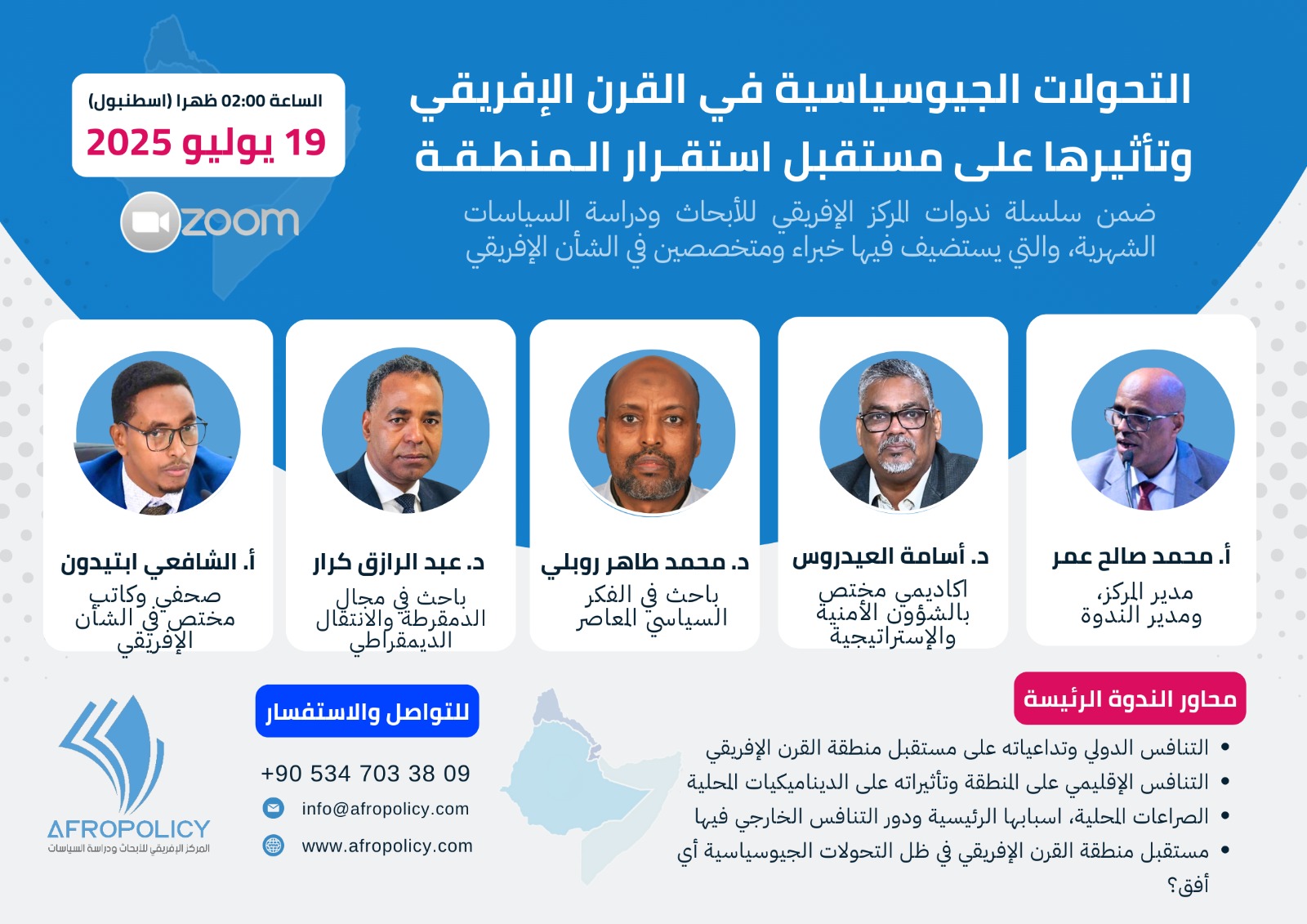
On July 19, 2025, the African Center for Research and Policy Studies (AfroPolicy) convened a timely virtual seminar titled “Geopolitical Transformations in the Horn of Africa and Their Impact on Future Regional Stability.”
The seminar was held in Arabic via the Zoom platform and moderated by AfroPolicy Director Mohamed Saleh Omar, who brought together four leading experts to explore the region’s growing complexity amidst shifting international and regional dynamics.
The Horn of Africa, home to critical maritime chokepoints, fragile states, and intensifying foreign presence, has become one of the most strategically contested regions in the world. With the civil war in Sudan, rising tensions between Ethiopia and its neighbours, and the expanding military footprint of global powers in Djibouti and beyond, the seminar offered vital insights into the causes, consequences, and possible futures of the region.
As Dr. Mohamed Taher warned during his talk, “This region is not just inflamed; it is permanently burning.”
Key Highlights / Outcomes
The seminar revealed a sobering portrait of the Horn of Africa’s geopolitical landscape shaped by overlapping layers of international rivalry, regional competition, and fragile domestic politics. Experts agree that the region is caught in a complex web of external and internal dynamics, each reinforcing the other and threatening long-term stability.
One of the central takeaways was the escalating militarisation of the region by international powers. Djibouti alone now hosts military bases from at least eight countries including the United States, China, France, and Japan, making it the densest concentration of foreign military presence in Africa. According to Dr. Mohamed Taher, this reflects not only the region’s geostrategic importance—controlling the Bab el-Mandeb Strait and 10–12% of global maritime trade—but also its enduring vulnerability to global power rivalries.
The seminar also highlighted how regional disputes increasingly feed into broader proxy dynamics. As Dr. Osama Eidrous pointed out, competition over Nile waters, maritime routes, and territorial claims created a “security dilemma in which regimes prioritise their own survival over regional cooperation. These tensions are compounded by new strategic concerns, such as control over undersea Internet cables and raising the stakes of cyber and hybrid warfare in the region.
Furthermore, local conflicts are amplified by external interference, whether through arms supplies, financial influences, or diplomatic manipulation. Civil war in Sudan, terrorist movements in Somalia, and the Ethiopia-Eritrea impasse were all cited as flashpoints made worse by competing international agendas.
In response, speakers called for urgent development of African-led peace frameworks. Dr. Abdul Raziq Karar emphasised the need for a regional confederation model, while media expert Al-Shafi’i Abtidon urged sustained intra-regional dialogue, regulated foreign military presence, and investment in infrastructure and inclusive governance. Without such initiatives, Horn risks becoming a permanent battlefield for others.
Panel Summaries
Panel I: International Competition
Dr. Mohamed Taher opened a seminar with a deep analytical overview of the international dimensions shaping the Horn of Africa. He framed the region’s strategic relevance using classical geopolitical theories, from Spykman’s Rimland to Gamal Hamdan’s crescent theory, arguing that the Horn sits at the intersection of global power routes, maritime control, and energy corridors. He identified four historical phases of international competition, from early Ottoman-Portuguese conflict to post-9/11 militarisation.
A key focus was the growing concentration of global military bases, particularly in Djibouti, where the U.S., China, France, Japan, and others have entrenched themselves, effectively turning the region into a geopolitical chessboard. The militarisation of the Red Sea corridor—through naval deployments, port acquisitions, and surveillance infrastructure—was described as both a symptom and a cause of regional volatility.
Dr. Taher highlighted a clear warning: “The Horn of Africa is not simply a hotspot, it is a geostrategic battleground where permanent tension is the norm.” His call to rethink global engagement policies centred on de-escalation, infrastructure-focused aid, and curbing the securitisation of diplomacy.
Panel II: Regional Rivalries
Dr. Osama Eidrous examined the internal fragmentation and regional ambitions driving Horn’s crisis. He argued that post-Cold War efforts at regional integration, such as through IGAD, have largely eroded because of competing national priorities and regime-centric security agendas. Citing Ethiopia-Eritrea disputes, Nile water tensions, and Gulf rivalries (notably the UAE, Saudi Arabia, Iran, and Turkey), Dr. Eidrous highlighted how external actors manipulate internal divides to shape influence blocs.
One emerging concern was undersea Internet infrastructure, where cyber geopolitics—especially between Huawei and Western firms—is becoming a quiet theatre of competition. He linked this to new-generation warfare strategies including drones, economic coercion, and information disruption.
Dr. Eidrous stressed that regime security often trumps national interests, making countries vulnerable to foreign agendas. He called for a regional security vision led by African scholars and policy practitioners that transcended narrow nationalistic frameworks.
Panel III: Local Conflicts
Dr. Abdul Raziq Karar redirected the discussion toward domestic responsibility, urging local actors to stop blaming foreign powers for all the region’s ills. He pointed out that 65 years after decolonisation and decades after the Cold War, Horn’s crises persisted not just due to external meddling but also because of elite failures and fragmented political orders.
He identified paradoxes such as Djibouti’s stability, despite hosting eight competing foreign military bases, suggesting that strategic value alone does not determine instability. Rather, it is the survival logic of ruling regimes that often sacrifice long-term state-building for short-term power consolidation, which fuels recurrent unrest.
With conflict zones spreading from Sudan’s bloody civil war to Somalia’s continued battles against Al-Shabab and ISIS, Karar argued that piecemeal solutions are no longer viable. He recommended a regional confederation model to address interlinked crises collectively while also warning against hardline diaspora influence, which often prolongs identity-based conflicts from afar.
Panel IV: Future Outlook
Media Analyst Al-Shafi’i Abtidon delivered the final presentation, painting three broad scenarios for Horn’s geopolitical trajectory. The first is continued polarisation driven by foreign military expansion and proxy politics, where instability becomes permanent. The second is a push for regional economic integration, as championed by Ethiopian Prime Minister Abiy Ahmed, which could strengthen resilience through shared infrastructure. The third scenario is more volatile: the redrawing of national borders by escalating separatist movements and ethnopolitical fragmentation.
He referenced the Red Sea flashpoints, including Houthi attacks on maritime shipping and Ethiopia’s contested quest for sea access, as urgent pressure points that could trigger a wider conflict.
Abtidon offered a constructive policy path: strengthen internal governance, promote inclusive dialogue, regulate foreign military expansion, and invest in cross-border development infrastructure. “We must break the cycle,” he urged, “where others define our security while we inherit the consequences.”
His concluding remarks echoed the core message of the seminar: African agency is not optional; it is essential for charting a viable, peaceful future for the Horn of Africa.
Quotes from Experts
🗣️ “The Horn of Africa is not simply a hotspot—it is a geostrategic battleground where permanent tension is the norm.”
— Dr. Mohamed Taher, geopolitical expert, highlighting the entrenched international rivalries shaping the region’s fate.
🗣️ “Regime security has become more sacred than national survival. Until that changes, no amount of peace agreements will hold.”
— Dr. Osama Eidrous, regional affairs analyst, critiquing the inward-looking priorities of ruling elites in the region.
🗣️ “We can no longer afford to treat Somalia, Ethiopia, or Sudan in isolation. Either we solve our problems together—or we fall apart alone.”
— Dr. Abdul Raziq Karar, political sociologist, calling for a unified regional vision to confront shared crises.
These voices underscored a recurring theme throughout the seminar, only a homegrown, collective approach can reverse the Horn’s trajectory from fragmentation to integration.
Voices from the Audience
During the interactive segment of the seminar, several audience participants contributed rich reflections that reinforced and expanded upon the expert presentations. Their comments revealed key thematic concerns shared by local intellectuals, activists, and observers across the Horn of Africa.
A recurring threat was the need for inclusive governance and the dangers of identity-based exclusion. Multiple attendees expressed concern that ethnic federalism and politicised identity discourses continue to fragment societies and hinder national cohesion, particularly in contexts such as Ethiopia and Somalia.
There was a call for new models of governance that transcend ethnic boundaries and prioritise the social contract between citizens and the state.
Another strong concern was voiced around the diaspora responsibility, echoing Dr. Karar’s points. Some participants noted that diaspora actors can either inflame or reconcile conflicts, depending on whether they support long-term institutional buildings or short-term factional agendas.
Perhaps the most poignant intervention came from a participant who urged regional and national actors to prioritise the protection of sacred cultural and religious spaces in conflict zones, warning that militarised expansion and external interference often violate heritage and spiritual dignity. This point, under the banner “Protecting Sacred Spaces”, added a moral and cultural dimension to the security discourse, reminding the audience that sovereignty is not just territorial, but also spiritual and civilisational.
Taken together, the audience contributions added urgency and depth to the seminar’s call for an African-centred, integrative response to the region’s challenges—one that defends not only borders but also identities, memories, and futures.
Organisational Insight
This seminar is part of AfroPolicy’s monthly strategic dialogue series dedicated to unpacking the evolving dynamics of the foreign presence and regional transformation across the African continent.
As a research-driven institution committed to policy relevance and an African agency, AfroPolicy uses these platforms to foster informed discussions among scholars, practitioners, and decision-makers.
Focusing on the Horn of Africa, a region at the crossroads of global and regional power competition, AfroPolicy continues to advance its mission to generate context-specific knowledge, promote cooperative security frameworks, and encourage African-led policy solutions grounded in regional realities rather than external prescriptions.
Conclusion
The seminar on Geopolitical Transformations in the Horn of Africa reaffirmed the urgent need for African-led solutions to counteract the region’s growing entanglement in international rivalries and fragmented national agendas. Experts agree that without a unified regional vision, Horn risks deeper instability and erosion of sovereignty.
AfroPolicy will publish a full seminar proceedings report and expert policy brief in the coming weeks (in Arabic version) as part of its ongoing commitment to informed dialogue and strategic analysis.
Future research will continue to examine regional fault lines and pathways for sustainable peace across the continent.
______________________
Footer / Credits
- Seminar Date: July 19, 2025
- Language: Arabic
- Writer & Editor: Mohamed Zakaria Fodol, on behalf of the AfroPolicy Research Unit
- Affiliation: Published by the African Center for Research and Policy Studies – AfroPolicy