
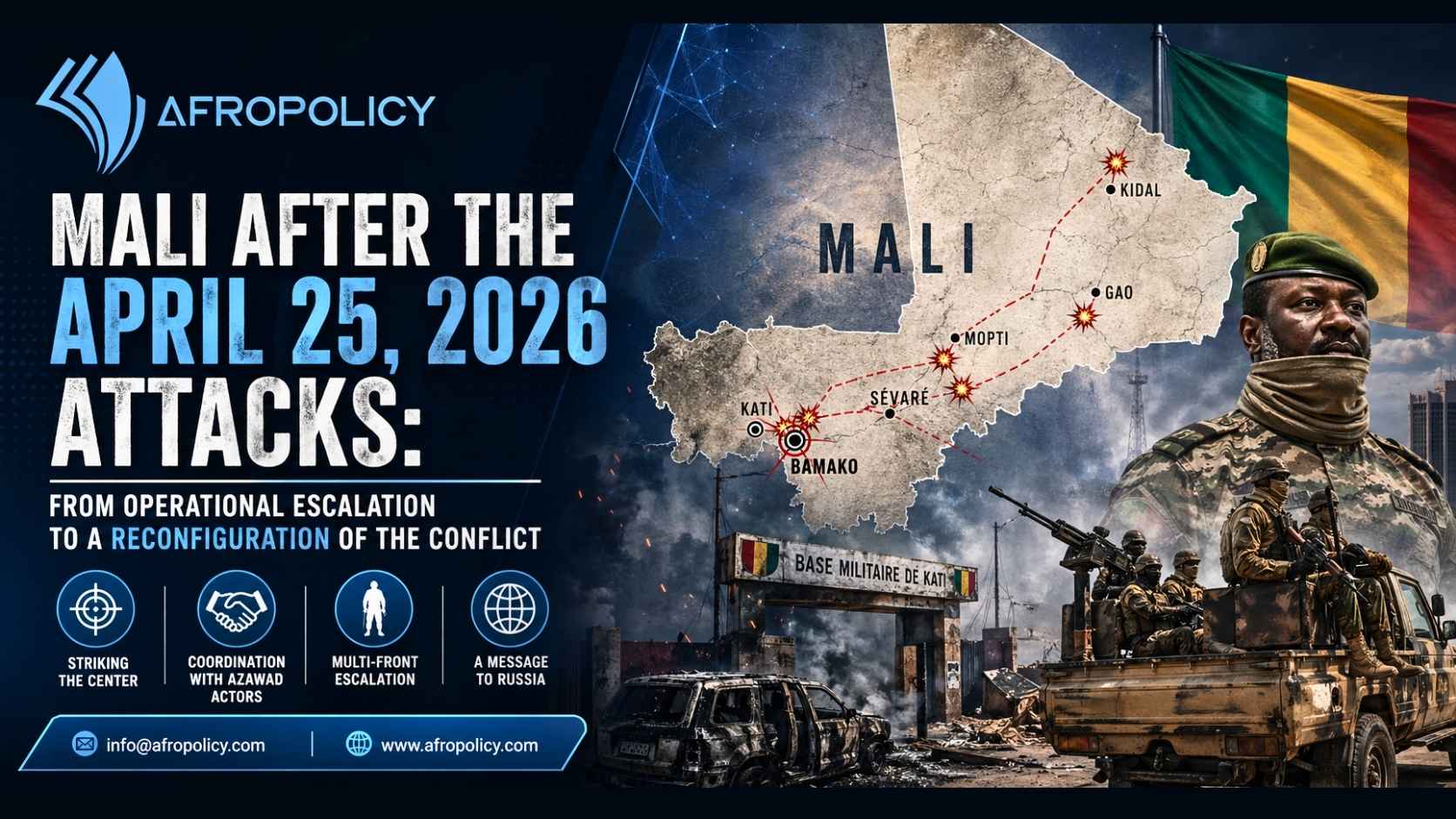
The attacks of 25 April 2026 in Mali mark a turning point in the trajectory of the conflict—not only because of their geographic scale or the density of their targets, but because they reveal a qualitative shift in how armed groups operate. Confrontations are no longer confined to the northern and central regions; they have extended to the outskirts of the capital, Bamako, targeting sensitive sovereign and military sites, including the Kati base, Bamako International Airport, and locations linked to the political and military leadership. This places the attacks among the most extensive waves of violence since the collapse of the north in 2012, with Kidal, Gao, Mopti, Sévaré, and Bamako all targeted within a short timeframe.
The significance of the event operates on three interconnected levels:
First, the scale and simultaneity of the operation across multiple cities and fronts.
Second, the direct targeting of the military power center, including the residence of Mali’s Minister of Defense, Sadio Camara, in Kati near the capital, where reports indicate he was killed in the strike.
Third, the content of the statement issued by the Group for the Support of Islam and Muslims (JNIM), which went beyond claiming responsibility to outline a new political and military framing of the conflict—particularly through references to coordination with the Azawad Liberation Front, to Russia, and to the targeting of President Goïta’s residence, with its strong symbolic implications.
First: Operational Details-Cities, Actors, and the Battlespace
The attacks began on the morning of Saturday, 25 April 2026 (approximately between 5:30 and 10:00 a.m. local time), marked by explosions and intense gunfire across several locations in Mali. The most significant clashes occurred near the Kati military base on the outskirts of Bamako. This site is not an ordinary barracks; it is a highly sensitive symbolic and security hub, historically tied to the structure of military rule in Mali and located close to the residence of transitional military president Assimi Goïta and the upper command circles. Reports indicate that two explosions and heavy gunfire were heard near Kati before 6:00 a.m., coinciding with attacks in Gao, Sévaré, Kidal, and Mopti.
The operation was clearly coordinated and simultaneous. Rather than a single assault on a barracks or a roadside ambush, it consisted of a series of strikes spread across northern and central Mali and the capital’s periphery. Targeted areas included Kati near Bamako; Sévaré and Mopti in the center; Gao and Kidal in the north; as well as locations around Modibo Keita International Airport in Bamako. This geographic spread is significant, as it demonstrates the capacity of armed groups in Mali to open multiple fronts at once—stretching the army and forcing it to divide its forces between defending the capital, stabilizing the center, and preventing the loss of the north.
The killing of Mali’s Minister of Defense, General Sadio Camara, marked the most serious development in the operation. The Malian government later confirmed that he was killed in an attack on his residence in Kati, carried out by a suicide car bomb, according to an official statement broadcast on state television. Reports also indicate that his second wife was killed in the attack, although authorities did not release a comprehensive casualty figure.
The symbolic weight of Camara’s death is considerable. He was not merely a technical minister but one of the central figures of Mali’s military leadership, closely associated with the country’s strategic pivot toward Russia following the decline of French and broader Western influence. Targeting him inside Kati, near the capital, signals that armed groups have moved beyond exerting pressure on peripheral regions to striking at the core of the regime. References in JNIM’s statement to targeting the president’s residence or its vicinity carry an even more consequential message: that the highest levels of leadership are no longer beyond operational reach.
In the north, the Azawad Liberation Front announced that it had taken control of Kidal—a city of high political and symbolic value since the 2012 crisis. Kidal is not simply a northern town; it represents the central state’s persistent failure to assert authority over Tuareg regions and remains a recurring focal point in Bamako’s confrontation with Azawad actors. Its re-emergence underscores that the crisis is no longer purely jihadist in nature, but once again combines the logic of separatist insurgency with transnational jihadism. While the Azawad Liberation Front declared control over Kidal, reports suggest that the situation on the ground remains contested in some areas.
Statement by the Group for the Support of Islam and Muslims: From Claiming Responsibility to Engineering a Political Message
The statement issued by the Group for the Support of Islam and Muslims (JNIM) is central to interpreting the operation. It does more than provide a propaganda narrative; it reveals how the group seeks to frame the event both politically and militarily. The statement presents the attacks as a “victory” and links them to multiple objectives: striking the core of the regime, exposing the army’s weaknesses, demonstrating the ability to coordinate with local actors, and sending a message to Russia.
The most consequential element in the statement is the reference to targeting the residence of the military president or its vicinity. This is not a minor detail. Targeting the president’s home or symbolic seat of power transforms the operation from a security incident into a sovereignty-level message: even the head of the regime is within reach. Even if the attack did not result in direct harm to the president, its symbolic value lies in breaking the perception of immunity surrounding the military leadership. In military regimes, the physical protection of the president and the surrounding security perimeter is part of the regime’s claim to authority. Once this circle is breached, the image of the state as capable of protecting itself—let alone the country—begins to erode.
The second key point is the targeting of Defense Minister Sadio Camara’s residence. If targeting the president carries symbolic sovereign meaning, then targeting the defense minister carries direct operational significance. Camara represented the security brain of the regime, and striking his home in Kati suggests that the group had precise intelligence regarding location, timing, and vulnerabilities. The use of a car bomb followed by subsequent clashes indicates a complex, multi-layered operation rather than a random attack. Such operations require reconnaissance, intelligence penetration, and the ability to breach what is assumed to be a tightly secured environment.
The third element is the reference to coordination with the Azawad Liberation Front. This point is particularly sensitive, as it elevates the relationship between jihadist actors and Tuareg movements from parallel exploitation of state weakness to a level of operational coordination. This does not necessarily imply ideological alignment or organizational merger, as their objectives differ: JNIM operates within a transnational jihadist horizon, while the Azawad Liberation Front is driven by a political and identity-based agenda rooted in the north. However, even temporary field coordination creates a compounded strategic effect—pressure in the center and south from jihadist actors, alongside advances or repositioning in the north by Azawad forces.
The fourth—and perhaps most innovative—aspect of the statement is its message to Russia. Rather than placing Russia solely in the category of an absolute enemy, the group signals the possibility of avoiding confrontation if Russian forces refrain from acting against it, and even hints at the potential for “balanced future relations” or a similar arrangement. This language is unusual in jihadist discourse and reflects a shift from rigid ideological framing toward a more pragmatic, strategic posture.
This message comes in the context of Russia’s transition from the Wagner model to the “Africa Corps,” formally linked to the Russian Ministry of Defense since June 2025. This shift marks an important transformation in the structure of Russia’s presence in Mali. The April operation thus becomes a dual test: a test of the Malian army, and a test of Russia’s new post-Wagner model.
The Malian Government’s Response: Declared Control versus Operational Shock
In response to JNIM’s statement, the Malian government sought to project a counter-narrative centered on control and containment. Authorities emphasized that the armed forces were engaged in operations against “terrorist groups,” that clearing operations were ongoing, and that the public should disregard unofficial information and propaganda. This type of messaging is typical in moments of crisis: the state aims to prevent panic, preserve the image of the military, and avoid fully acknowledging the scale of the breach.
However, the official narrative appeared general and limited when compared to the level of detail provided by the group’s statement. When the group identifies specific targets—such as Kati, Bamako Airport, the defense minister’s residence, and the vicinity of the presidency—and when the Azawad Front declares control over Kidal, while the state maintains a broad claim of control, a credibility gap begins to emerge. The issue is not who holds the complete truth, but who is more capable of presenting a coherent and convincing narrative to the public.
The confirmation of the defense minister’s death the following day further deepened the shock. The killing of a figure of this stature inside Kati cannot be contained by a simple “situation under control” narrative. It signals a significant security breach within one of the most critical military circles of the state. As a result, the government’s response—despite attempts to appear reassuring—reveals the limits of a security model heavily reliant on militarization, particularly when facing an adversary capable of combining coordinated field operations with effective political messaging.
Outcomes of the Operation and the Evolution of the Conflict in Mali
The first and most immediate outcome is that the conflict in Mali has entered a phase where the center—not just the periphery—is being directly targeted. For years, the Malian state treated armed groups as a northern or central problem, one that could be contained through military campaigns and external partnerships. The April attacks, however, demonstrate that Bamako and its surroundings are no longer insulated from pressure. Kati, given its proximity to the capital and its symbolic weight within the military establishment, turned the attack into what appears to be a test of the regime’s own resilience.
The second outcome is the return of Kidal to the heart of the equation. Any shift in Kidal’s status inevitably reopens the question of sovereignty in the north. If jihadist pressure intensifies in the center and south while Azawad actors consolidate or reposition themselves in the north, the state faces a layered conflict that cannot be addressed as a counterterrorism issue alone.
The third outcome is the transformation of the relationship between JNIM and the Azawad Liberation Front into a decisive field factor. Even without a formal alliance, temporary operational coordination is enough to alter the balance of the conflict. The state is then compelled to confront actors with different objectives but converging pressures at critical moments.
The fourth outcome is the erosion of the Russian partner’s image. The Malian military leadership has built part of its legitimacy on replacing France with what it presents as a more effective security partner. The April attacks challenge this narrative. The failure to prevent the operation, the killing of the defense minister, and the instability in Kidal all raise questions about the effectiveness of the Africa Corps in filling the post-Wagner security vacuum.
Future Trajectories of the Conflict
The first possible trajectory is a broad military escalation by the state, particularly around Bamako, Kati, and central regions, coupled with attempts to regain the initiative in the north. While plausible, this scenario carries a clear risk: if the response takes the form of large-scale operations without addressing intelligence failures and local governance gaps, it may simply reproduce the same cycle.
The second trajectory involves the consolidation of operational coordination between JNIM and certain Azawad components. This would not necessarily imply merger, but rather a functional division of roles: jihadist actors exert pressure on the center and south, while Azawad groups reshape the north. This represents one of the most serious threats to the territorial cohesion of Mali.
The third trajectory is the intensification of the information war. JNIM’s statement shows that the group is not only conducting operations but also actively shaping their meaning. If the state does not develop a more precise and transparent narrative, it risks losing part of the battle over perception—particularly in areas where trust in state institutions is already weak.
The fourth trajectory concerns Russia. The message directed at Moscow opens two possibilities: either Russia responds with greater escalation to reinforce deterrence, or it shifts toward a more cautious management of its engagement. In both cases, the group has demonstrated its awareness of the importance of external actors and its intent to influence them, not merely resist them.
Conclusion
In sum, the attacks of 25 April 2026 are not simply another wave of violence in Mali; they expose a deeper transformation in the nature of the conflict. What is unfolding is a multi-layered confrontation that targets the center, reactivates the northern question, and combines field operations with strategic messaging. The most critical dimension of the event is not only the number of cities targeted or the killing of Defense Minister Sadio Camara, but the way JNIM has articulated a new vision of the conflict: coordination with Azawad actors, direct targeting of state symbols, and a calibrated message to Russia.
In this sense, Mali is no longer facing isolated armed groups, but a conflict environment that is adaptive, strategic, and capable of exploiting both state fragility and the limitations of its alliances. The central question is no longer simply whether Bamako can restore control, but whether it still possesses a political and security model capable of preventing the crisis from evolving into a broader fragmentation—one that echoes 2012, but with more complex actors and far more dangerous dynamics.
___________
Note: This piece is translated from Arabic. The original link is here

